Australian Airbnb management company Hometime reports the following figures from the Oasis concerts in Melbourne:
Occupancy rate: 97%
Average nightly rate increase: +35–40%
Booking lead times: 6–8 weeks before the event
Key suburbs: Docklands, Melbourne CBD, North Melbourne, Carlton, Fitzroy, Collingwood, and other transit-linked areas
Australia’s short-term rental market hits new heights as the highly anticipated Oasis reunion concerts sent demand for local accommodations soaring. With thousands of fans flooding into Melbourne, STR management company Hometime recorded a staggering 97%occupancy rate across our properties, marking one of the highest spikes since pre-pandemic tourism booms.
“The Oasis concerts created a clear surge in Melbourne demand, with short-term rental properties experiencing significant uplifts in both occupancy and nightly rates,” said Abdullah Mohammad, Senior Manager of Revenue and Pricing at Hometime. “Occupancy reached 97% over the three-day period of the concerts, while nightly rates increased by 35–40% on average.”
Hometime also reports a 19% uplift in RevPAR, 9% higher occupancy, and a 24% increase in accommodation revenue during the Oasis concerts compared with the same period last year.
Capitalising on demand spikes is key to profitability
Melbourne has always been a popular tourist destination, with a healthy year-round mix of business travel, events and leisure trips. But event-based surges in short-term rentals are causing fluctuations in the market, which many hosts struggle to take advantage of.
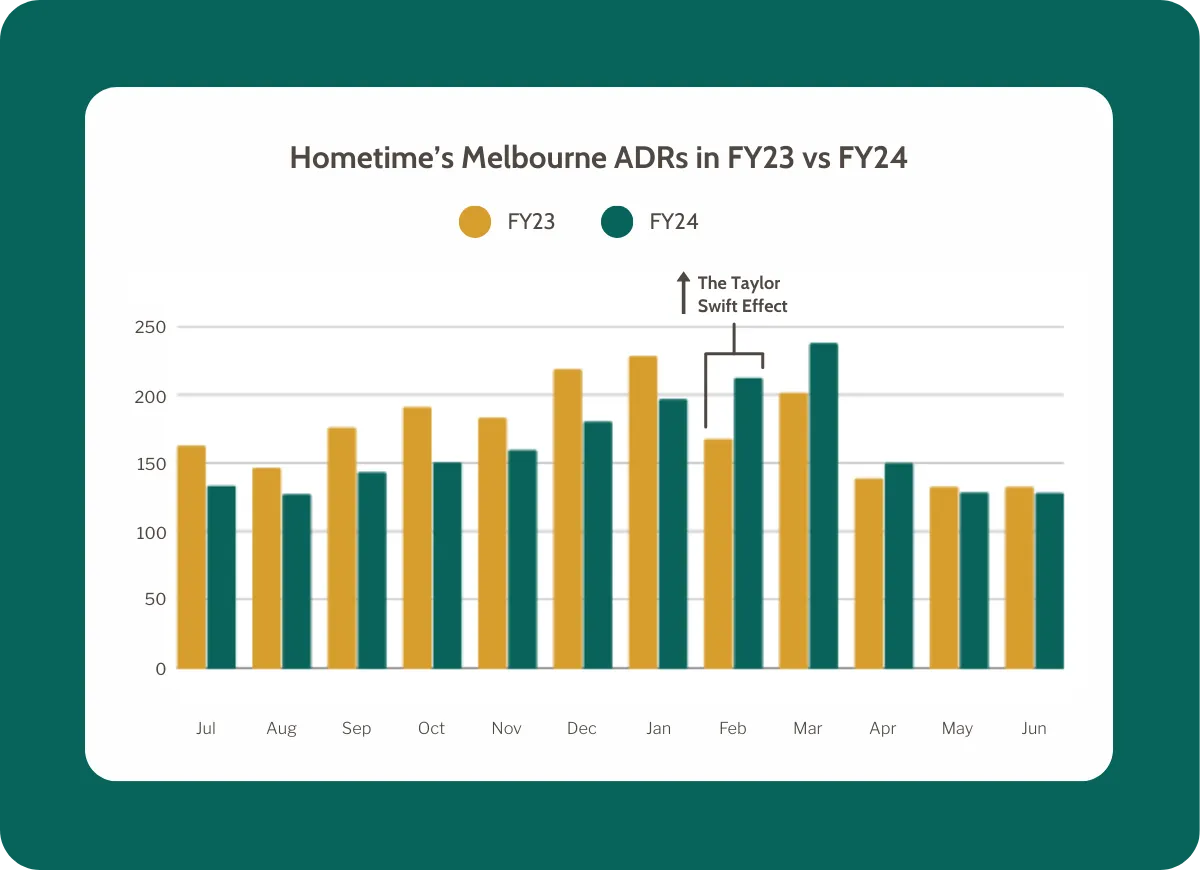
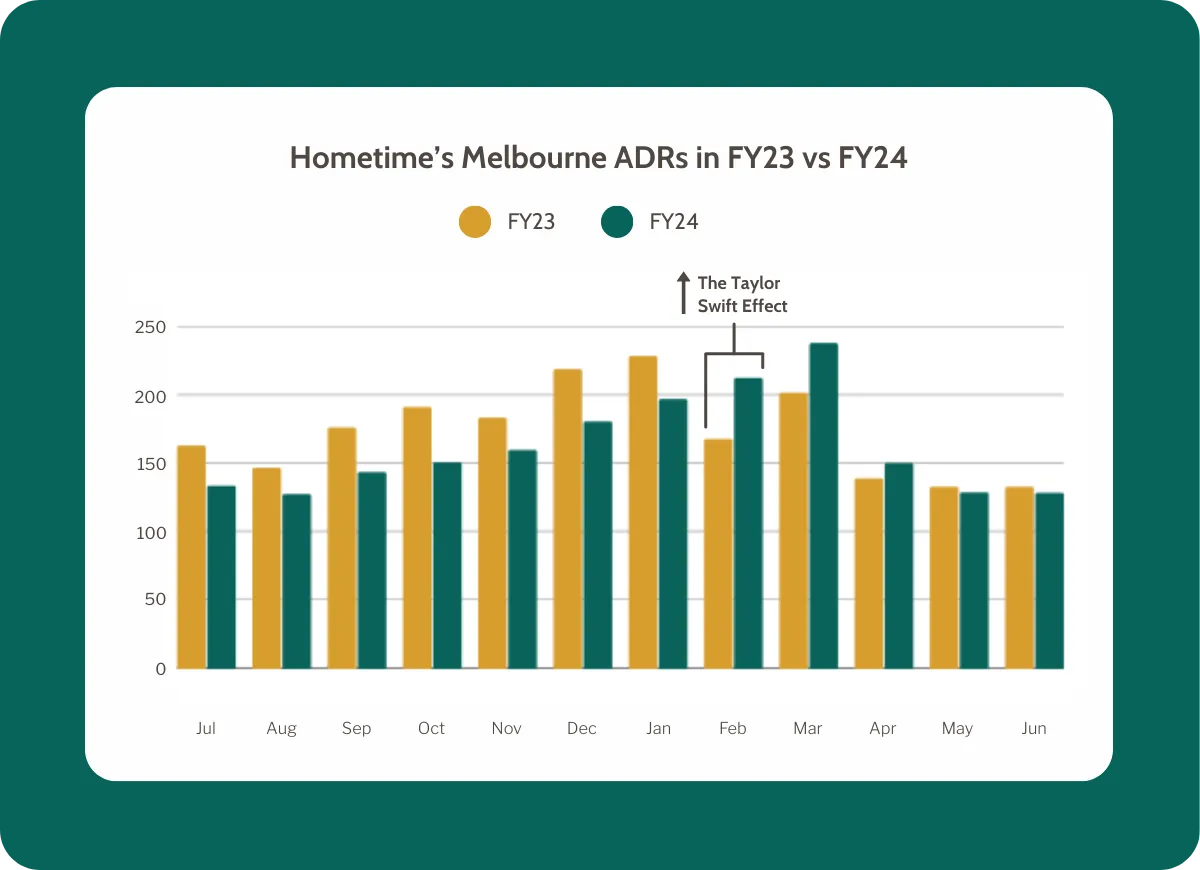
“Average daily rates (ADRs) in Melbourne typically fluctuate around major events in the city. Two major events that consistently draw a large influx in demand every year are the Australian Open in January and the Formula 1 Australian Grand Prix in March. Recent concerts by international artists also cause similar surges, as seen in February FY24 with Taylor Swift and October FY25 with Oasis,” said Abdullah.
Significant increase in Melbourne’s average daily rates (ADRs) in Feb FY23 vs FY24 due to Taylor Swift concerts.
“Tighter price management, which includes stronger event nightly rate strategies and proactive pacing adjustments, are essential. By leaning into real-time signals, you can capture significantly higher returns for your property,” said Abdullah. “For owners, this translates into a meaningful earnings boost and a strong demonstration of how strategic event-based revenue management turns major cultural moments into tangible financial upside.”
Events-based tourism is changing booking patterns
For most visits in Melbourne, you tend to see a familiar pattern: intrastate visitors typically stay only 1–2 nights and book closer to their travel dates, while interstate and international visitors stay longer and book much earlier. With Oasis and other similar events, this pattern is amplified.
“The concentrated spike in ticket-driven demand means earlier pick-up and opportunities to extend minimum stays as fans look to combine the concert with general sightseeing of Melbourne, allowing you to maximise both length of stay and nightly yield,” said Abdullah. “There is also strong compression across key suburbs, with properties in the Docklands and CBD booked first, then spilling out to North Melbourne, Carlton, Fitzroy, Collingwood, and other transit-linked areas, which fill more rapidly than normal. ”
For short-term rental owners, key booking patterns include:
A noticeable pull-forward in the booking window, with properties filling months earlier than a “normal” spring weekend.
Compression across neighbouring dates, especially the Thursday before and the Sunday–Tuesday between shows.
More multi-night bookings, particularly 3–5 night stays that combine the gig with sightseeing, food, sport and shopping in Melbourne.
How other markets react to events-based tourism
This phenomenon isn’t unique among short-term rentals in Melbourne — events drive demand, occupancy rates, and average daily rates for short-term rentals across Australia. Take a look below to see how events-based tourism affect key regions:
Sydney: Concerts like Taylor Swift's highly-anticipated tour in 2024 caused spikes in occupancy and nightly rates, even during off-peak seasons. Hometime reports a 98% occupancy rate for properties in the area during the dates surrounding the concerts.
Brisbane: Steady visitor numbers throughout the year, largely due to the packed events calendar in the area. Tourist numbers are expected to pick up further in the years leading up to the 2032 Brisbane Olympics and Paralympics.
Gold Coast: While most visit the region for the gorgeous beaches and the theme parks, the Gold Coast is also quickly becoming a hotspot for those who wish to participate in annual cultural events such as the Gold Coast Film Festival and the Promiseland Festival.
Why dynamic pricing is essential to events-based stays
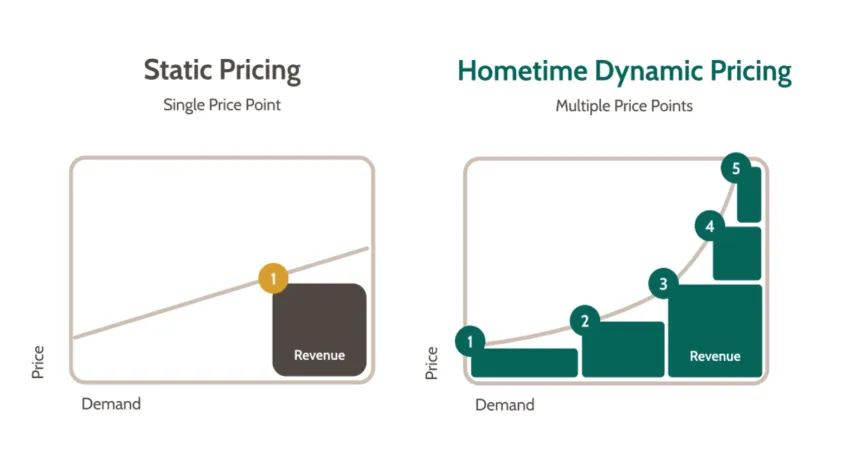
Static pricing, or using a singular price point, doesn’t cut it anymore for STRs. Instead, homeowners should embrace dynamic pricing, which adjusts your property’s base price by taking the following price points into account:
Seasonality: Pricing increases during peak season and decreases during off-peak seasons, especially for properties in highly seasonal markets like the Northern Territory and Northern Queensland.
Day of week: Prices trend higher on weekends due to greater demand, while it trends lower on weekdays due to less demand and to fill in any booking gaps.
Booking lead time: Rates vary depending on how far ahead a customer makes their booking, with potential last-minute discounts taken into consideration.
Booking pace: Pricing updates in line with real-time booking pace, or the number of bookings currently being made for a listing. We increase the price when booking pace is high and decrease it when booking pace is low.
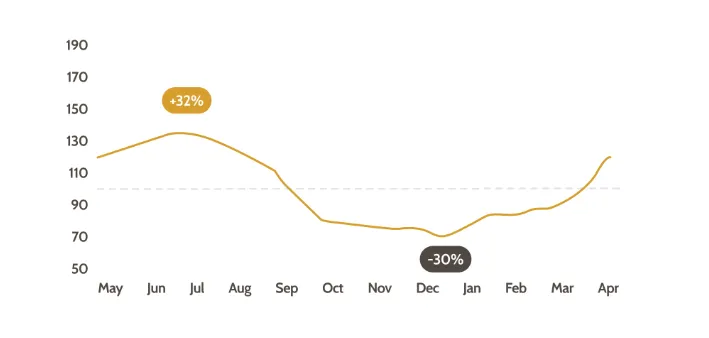
Here's an example of what your nightly rate might look like (assuming a base price of 100 AUD) after it's adjusted for seasonality, with up to a 32% increase during peak seasons and a 30% decrease during off-peak seasons:
Nightly rates for an Airbnb, after dynamic pricing factors are taken into account.
Any additional increases related to holiday and events are then added on top of all these aforementioned price points. This ensures that you maximise your earnings during these brief periods where demand is higher than normal due to an event taking place in the area.
Future implications
Australia’s packed events calendar continues through 2026 with the Australian Grand Prix, the AFC Women’s Asian Cup, the Rugby League World Cup, plus blockbuster tours like Ed Sheeran’s Mathematics tour. Event-based tourism is also expected to further accelerate as Australia prepares to host the 2032 Brisbane Olympics and Paralympics. This makes strategic planning and event-specific preparations more important than ever for short-term rental hosts. The question is: How can you ensure you’re prepared for the next time Oasis, Taylor Swift, or any other major event comes to town?
Some key tips include:
Set your prices early to attract early booking guests, then push prices higher as market occupancy increases
Set your minimum stays to 2–3 nights to attract longer stays while avoiding pushing other eventgoers to other properties offering shorter stays
Monitor bookings in your area to make sure that you’re competitive
You may also consider partnering with professional Airbnb managementin Melbourne for pricing management built around your property’s unique earning potential. STR managers combine expert insight and market context to help you stay ahead of the curve, using real-time signals to proactively adjust pricing and minimum night stays.
Why professional Airbnb management makes a difference
As the demand for short-term rentals across Australia increases, so does the level of competition, with many self-managing hosts struggling to keep up. Homeowners also have to deal with guests’ rising expectations for cleanliness and amenities, along with stricter regulations from the government and local councils. This means that hosts can no longer rely on luck or passive strategy; they must optimise every aspect involved in Airbnb management to stay competitive, which often amounts to at least 20-40 hours of work per week.
And while you could afford a mistake here and there in the past, gaps in your self-management strategy can be easily-magnified in today’s hyper-competitive market, with higher risks of delisting, fines, or negative reviews, all resulting in the same thing: lost income.
That’s where professional short-term rental management comes in — Airbnb managers like Hometime not only help set up your property, they also help set it up for success with the following services:
Regulatory compliance and property setup: Professional managers ensure that your property is Airbnb-ready: this means staying up-to-date with new STR and Airbnb rules in your area. This also includes navigating Airbnb day limits — expert management can also help you utilise workarounds like Sydney’s exemptions for stays longer than 21 consecutive days, which don’t count toward its 180-day annual limit.
Listing optimisation: Airbnb SEO, professional photography, tailored descriptions, and fast guest communication to boost conversion rates and secure five-star reviews.
Revenue management: Using real-time data and market insights to dynamically adjust your Airbnb’s pricing strategy and minimum night stay settings, maximising income during peak seasons and keeping occupancy strong year-round.
Channel management: Many self-managing hosts make the mistake of just using Airbnb, often forgetting about the impact of distributing listings across multiple STR sites to increase your visibility and bookings. This includes Airbnb and alternatives like Booking.com, Vrbo, and more, which have different audiences and markets.
Guest and property care: From hotel-quality short-term rental cleaning to round-the-clock property maintenance, a professional manager ensures guests are looked after and properties stay in top condition.
The results? On average, Hometime homeowners can earn 15% more and improve conversions by up to 36% compared to self-management.
Schedule an obligation-free chat to know more about how professional management can help maximise your returns.